
Why a maturity model?
You can't skip stages. Most failed transformations tried to.
The most expensive mistake in revenue operations is reaching for the stage you want before you've earned the one you're on. AI on top of dirty data produces confident nonsense. Automation on top of a broken process just makes the breakage faster. Scaling a motion you haven't made repeatable multiplies the chaos.
BETA exists to stop that. Each stage builds on the integrity of the one before it. The diagnostic question is never "what's the latest thing?" — it's "what's the next thing for you?"
The BETA™ framework
Four stages of GTM operations evolution.
Most revenue advice assumes every business needs the same thing. It doesn't. A startup finding its first repeatable motion has nothing in common with an enterprise drowning in tool sprawl — except that both are stuck at a stage they've outgrown.
BETA is a maturity model. It maps where your revenue operations are today, and what the next stage genuinely requires — so you invest in the right work, in the right order, instead of buying tools and tactics that solve a problem you don't have yet.
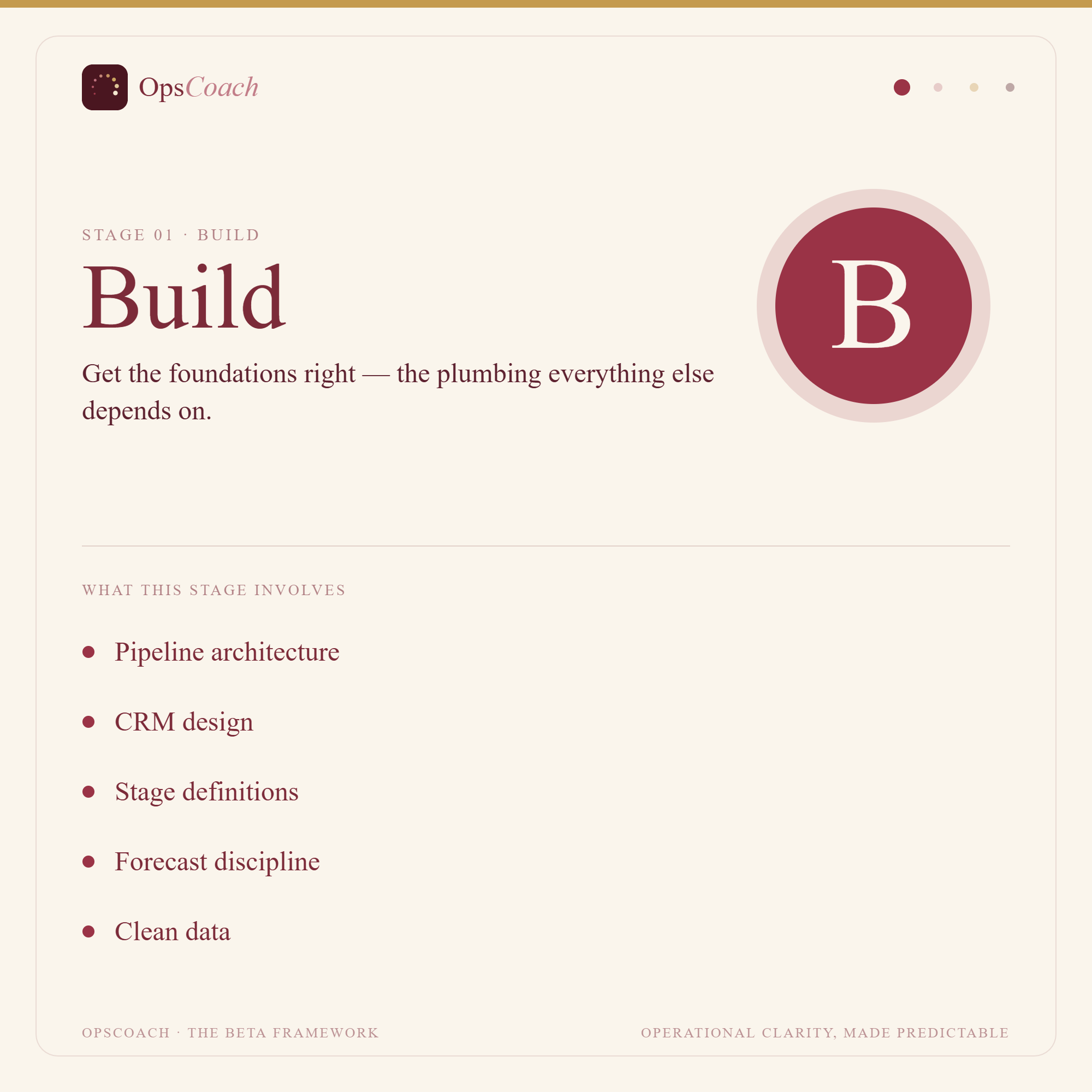
Stage B — Build
Get the foundations right.
The plumbing. Pipeline that reflects how deals really move. A CRM built on purpose, not accreted by accident. Forecast discipline that's enforced, not hoped for.
What this stage covers
- Pipeline architecture and stage definitions, with real entry and exit criteria
- CRM design and clean-up (Salesforce, HubSpot)
- Forecast models and forecasting cadence
- Data hygiene, structure, and integrity
- Core reporting and dashboards leadership can trust
You're at this stage if: the number is always a guess, reporting takes days, and no two people define “qualified” the same way.
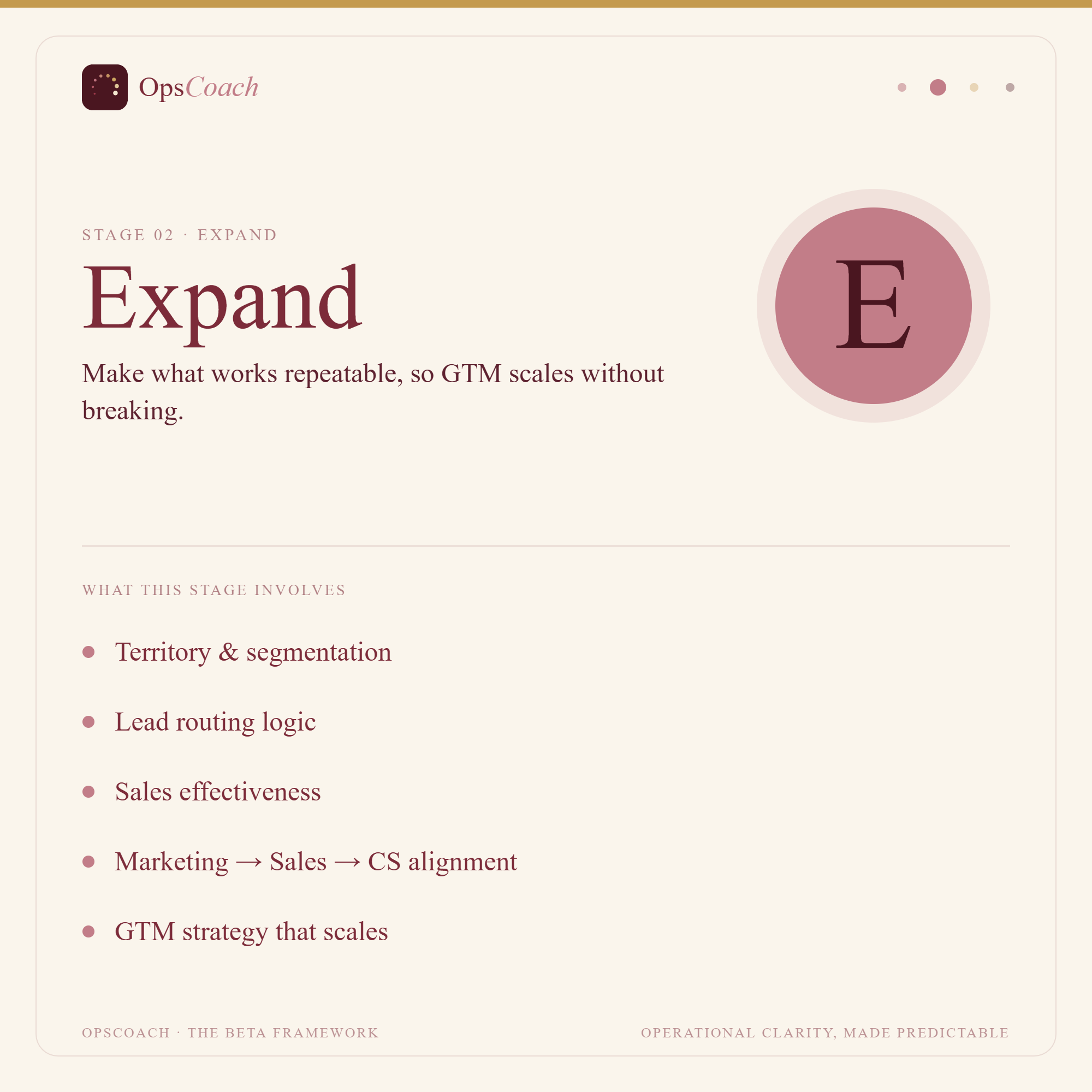
Stage E — Expand
Make what works repeatable.
Foundations hold. Now effort becomes a system. Territories drawn by design, not inheritance. Leads routed by logic, not luck. One definition of a good customer, shared across every function.
What this stage covers
- Customer segmentation and Ideal Customer Profile definition
- Territory planning and carve design
- Lead-funnel analysis, routing, and conversion optimisation
- Sales effectiveness and enablement
- Go-to-market strategy and motion design
- Marketing → Sales → Customer Success alignment
You're at this stage if: results depend on who's doing the work, leads fall through the gaps between teams, and growth feels effortful, not compounding.
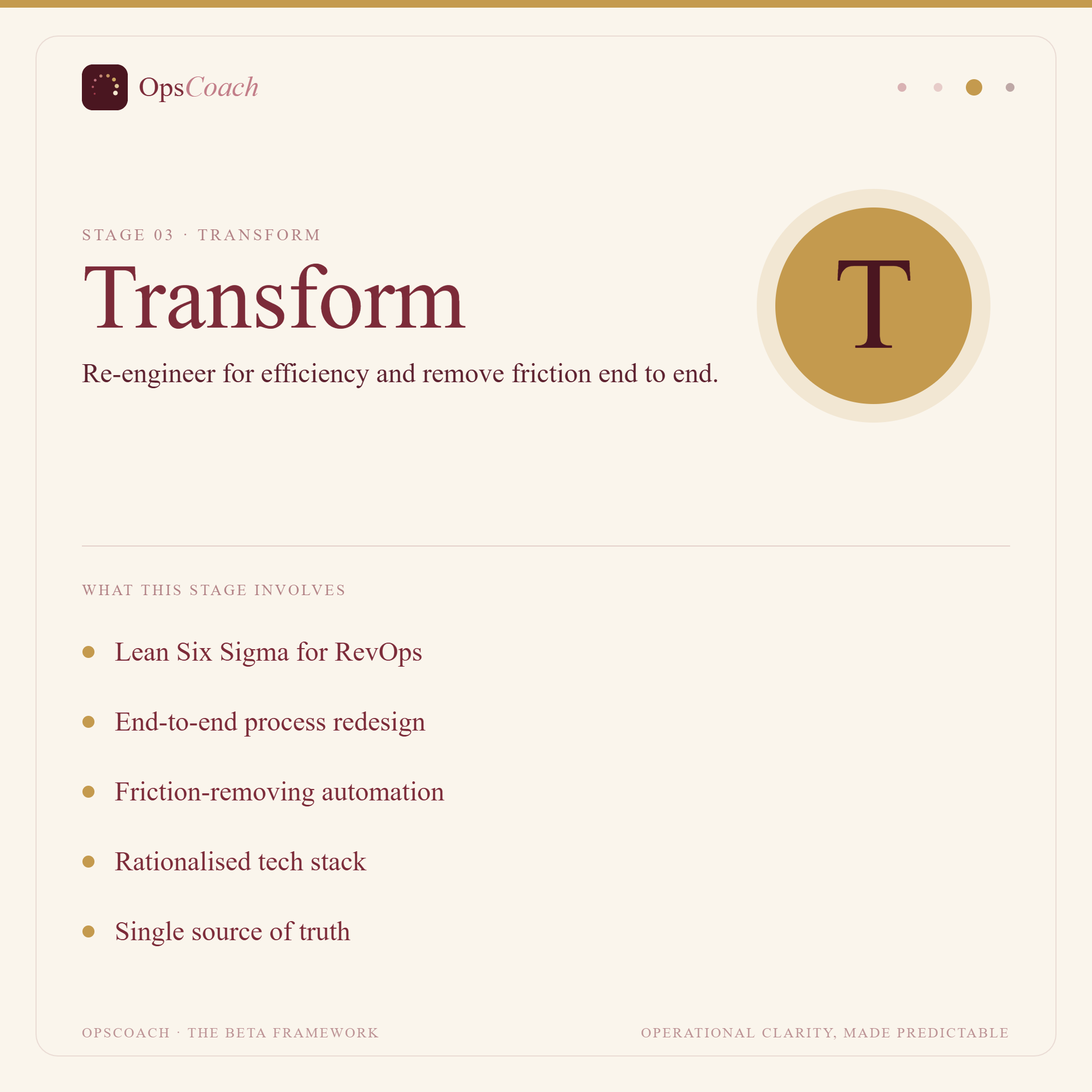
Stage T — Transform
Re-engineer for efficiency.
The systems work, but they've gotten heavy. Tools nobody uses. Steps that exist because they always have. This stage strips the weight out and rebuilds it lean.
What this stage covers
- Lean Six Sigma applied to revenue and GTM operations
- End-to-end process redesign and optimisation
- Tech-stack review, rationalisation, and integration
- Workflow automation that removes manual effort
- A single source of truth across the GTM stack
You're at this stage if: you're paying for tools nobody uses, the team feeds the systems more than it sells, and the same number lives in five places that disagree.
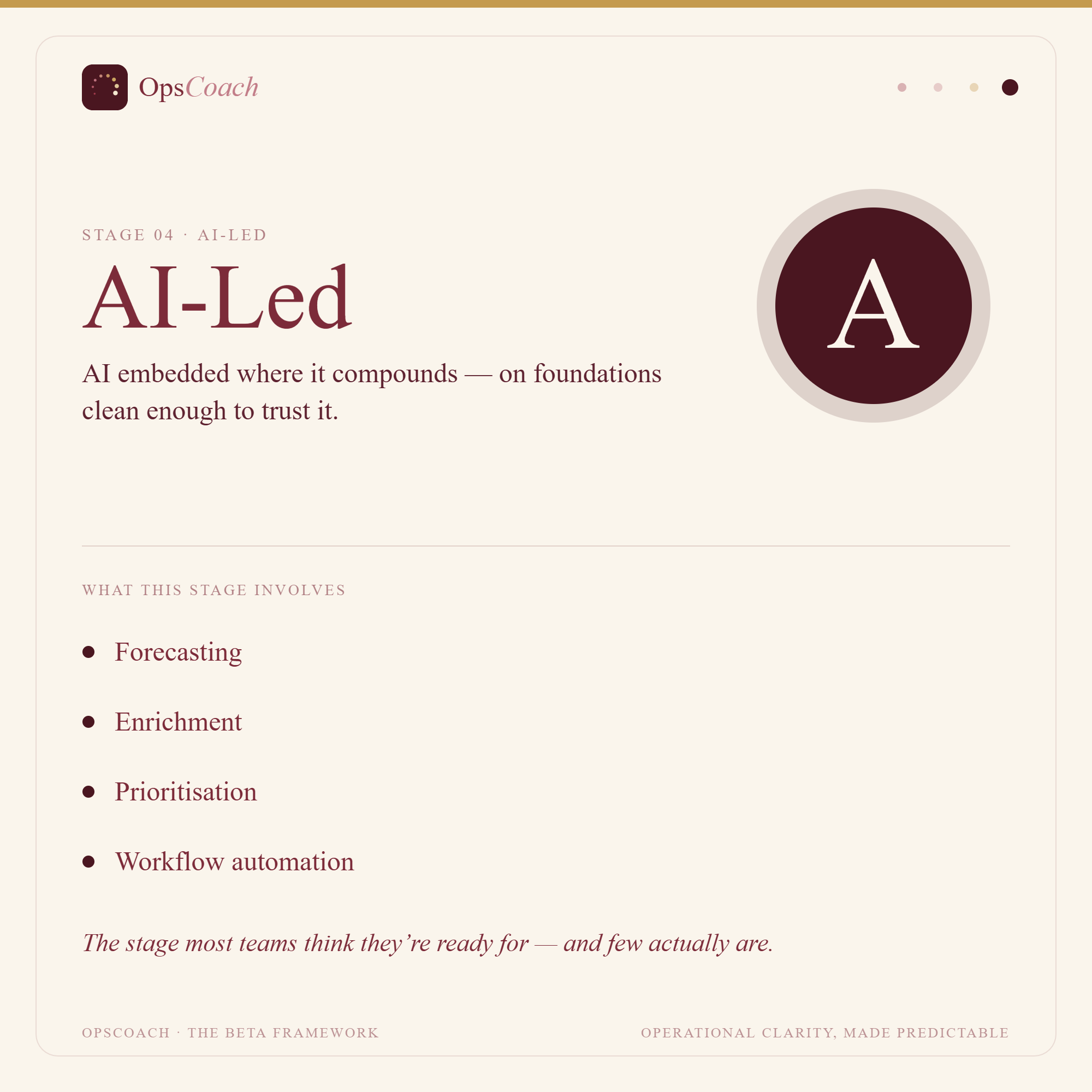
Stage A — AI-Led
Where operations become an advantage.
Everyone wants this stage. Few are ready for it. AI doesn't fix a broken engine — it amplifies whatever it's built on. Clean foundations, and it compounds: forecasting that learns, prioritisation that happens unprompted. Dirty foundations, and it just produces confident nonsense at scale.
What this stage covers
- AI embedded in forecasting, scoring, and prioritisation
- Automated enrichment, research, and data maintenance
- AI-augmented GTM workflows and decision support
- Governed AI adoption, built on foundations clean enough to trust
You're at this stage if: the foundations are solid, the process is lean, and the next gain has to come from intelligence, not effort.
(Not there yet? That's not a failure — the highest-leverage work is just earlier on the curve.)
How engagements run
Diagnose. Rebuild. Operate.
Whichever stage you're on, the engagement follows the same rhythm.
Diagnose
A clear-eyed audit of where you are on the BETA curve and what's holding you back. You get an honest assessment and a prioritised roadmap, whether or not we work together further.
Rebuild
We do the work the stage requires — foundations, scaling systems, re-engineering, or AI — in the right order, with clear scope.
Operate
Fractional support to run the cadences, hold the standards, and make the system self-sustaining. Or a fixed-scope project with a defined finish.